Your body often notices before your mind has found the words. A tight jaw before a difficult call. A shallow breath after a crowded commute. A sudden heaviness when you agree to something you do not have capacity for. This embodiment practice starter guide is an invitation to meet those signals with attention, rather than pushing past them.
Embodiment is not about becoming endlessly calm, positive, or productive. It is the quiet practice of inhabiting your own experience: sensations, breath, posture, emotion, energy, and the changing needs of your nervous system. For people who spend much of the day thinking, caring for others, creating, or holding it together, this return can feel both simple and profoundly unfamiliar.
What embodiment practice actually means
Embodiment is awareness that includes the body. Rather than asking only, “What do I think about this?”, you begin to ask, “What is happening within me right now?” The answer may be physical - warmth in the chest, a clenched stomach, tired eyes - or emotional, such as grief, relief, irritation, tenderness, or fear.
This is not an exercise in analysing every sensation. It is a relationship built through gentle noticing. When we live mainly in our thoughts, the body can become a vehicle we manage or ignore. Embodiment offers another possibility: the body as a source of information, boundary, memory, and presence.
For some, a seated meditation is the most accessible doorway. For others, stillness feels agitating or brings up too much too quickly. Movement, sound, warmth, or contact with the natural world may be more supportive. There is no single correct route back to yourself.
Begin with safety, not intensity
A meaningful practice does not need to be dramatic. In fact, intensity is rarely the goal for beginners. The nervous system learns through repetition and choice. A small moment you can return to each day is often more regulating than an occasional experience that leaves you overwhelmed.
Before beginning, orient to your surroundings. Feel the surface beneath your feet or body. Notice three neutral details in the room: the shape of a window, the texture of fabric, the quality of light. Let your eyes move slowly. This simple act reminds the system that you are here, in the present, and able to choose what happens next.
Then ask a modest question: What feels available today? Perhaps it is one fuller breath. Perhaps it is standing by an open window. Perhaps it is placing a hand over your heart and another on your lower belly. Availability matters more than ambition.
If you have experienced trauma, panic, dissociation, or feel distressed when bringing attention inward, work slowly and consider support from a qualified mental health professional. Embodiment can sit beautifully alongside therapeutic care, but it is not a replacement for it. Looking around the room, feeling your feet, or focusing on an external sound may be more appropriate than closing your eyes or going deeply into sensation.
A five-minute embodiment practice to try
Choose a time when you are unlikely to be interrupted. You do not need special clothing, a perfect room, or an elaborate ritual. Sitting upright, lying down, or standing are all welcome. The most supportive position is the one that allows you to breathe without strain.
Start by noticing your points of contact: soles of the feet, legs on a chair, back against a cushion, hands resting in your lap. Do not force relaxation. Simply register that you are held.
Let the exhale become slightly longer than the inhale for three or four breaths. If breath awareness feels uncomfortable, return to the contact points instead. There is no need to make the breath deep. Natural and unforced is enough.
Now bring attention through the body in broad areas. Notice the face, throat, chest, belly, hands, and legs. At each place, name only what is true: tight, soft, buzzing, numb, warm, neutral, tired. Neutral is a valid sensation. You are not searching for a breakthrough.
Finish by asking, What is one kind response I can offer myself in the next hour? It might be water, a stretch, a clearer boundary, a slower walk, food, rest, or a message you have been avoiding. Let the practice lead towards one grounded act of care.
Let movement carry some of the work
For many people, embodiment becomes easier when the body is allowed to move. A long exhale while rolling the shoulders, swaying gently to music, stretching after sleep, or walking without headphones can create more space than trying to sit still through a busy mind.
Try moving at a pace that feels almost too slow. Notice where your weight shifts as you walk. Feel the heel meet the ground, then the sole, then the toes. Let your arms move naturally. This is not about making a walk mindful in every second; it is about returning to sensation when you remember.
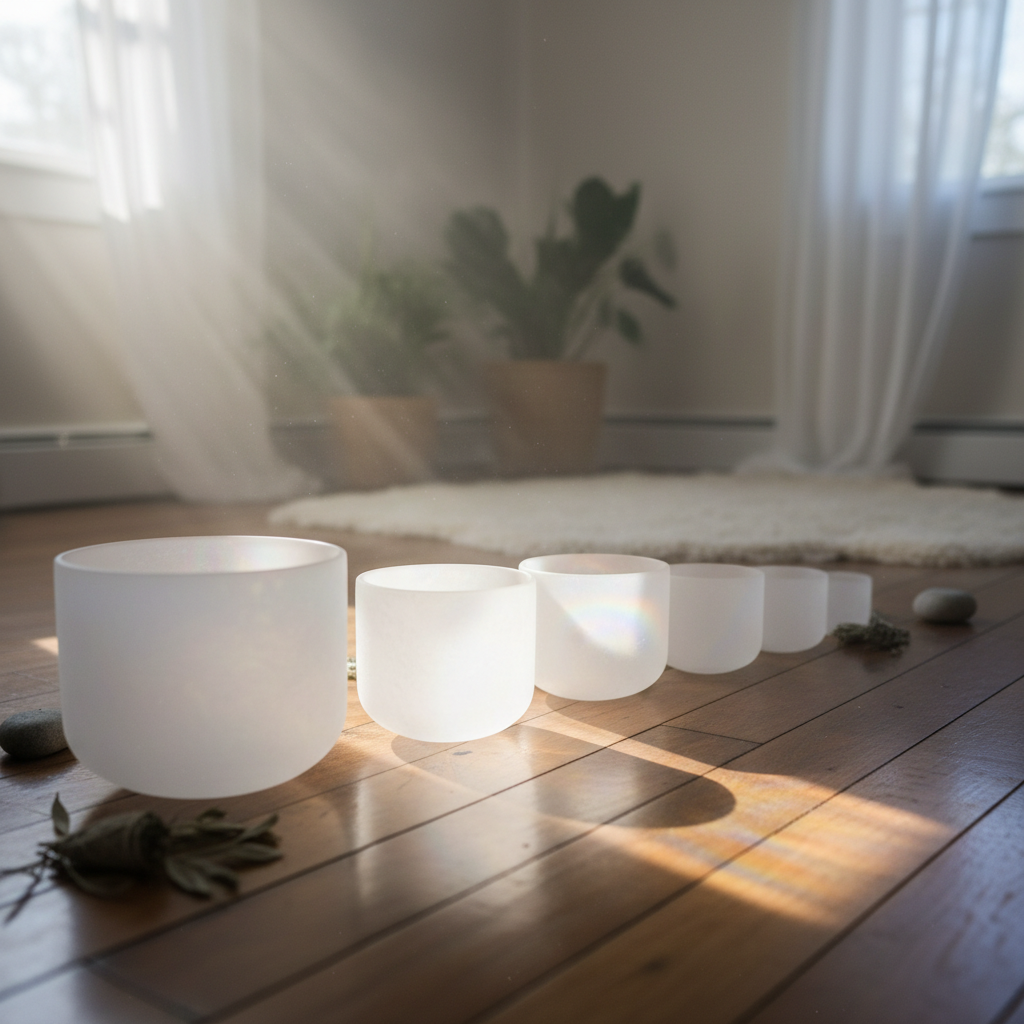
Sound can also support a felt sense of presence. Humming softly, singing a single note, or listening to sustained, spacious tones may help the body settle without needing to explain itself. A guided sound bath can offer a held environment for this kind of listening, especially when you find it difficult to create quiet on your own. At Luminous Resonance, the intention is not to perform spirituality, but to create room for what is already asking to be felt.
Create a ritual that fits your real life
The most sustainable embodiment practice is one that belongs in the life you actually have. If mornings are rushed with children, commuting, or caring responsibilities, a twenty-minute ritual may become another demand. A two-minute pause before opening your laptop may be far more honest and effective.
Anchor your practice to an existing moment. You might feel both feet on the floor while the kettle boils, take three slow breaths before entering your home, or place a hand on your chest before sleep. Repetition gives the body a familiar pathway back to itself.
You may also find it helpful to create a small sensory cue: a particular blanket, a cup of cacao, a candle, a piece of music, or a journal kept beside the bed. The object is not magical on its own. Its value is in the association you build: this is a moment when I do not have to abandon myself.
After a longer practice, write a few lines rather than trying to interpret the whole experience. “My shoulders dropped when I stopped rushing.” “I felt sad, then hungry.” “I did not feel much today.” These observations are enough. Over time, journalling can reveal patterns between your inner state, your relationships, your workload, and what restores you.
Common obstacles are part of the practice
“I cannot feel anything” is a common response, particularly for those who have spent years functioning through stress. Numbness is not failure. It can be a protective response, and noticing it is already a form of contact. Stay with simple external anchors and keep the invitation light.
Restlessness is equally common. Rather than treating it as something to defeat, name it: There is restlessness here. Then give it a safe outlet through walking, shaking out the hands, or stretching. The practice is not to become still at all costs. It is to listen without judgement.
Some days you may feel more connected after thirty seconds than after half an hour. Other days, the body may need sleep, conversation, practical support, or space from stimulation rather than another inward exercise. Embodiment is not a performance of wellness. It is learning to respond to what is true.
Let presence become a quiet form of self-trust
You do not need to wait for a retreat, a life change, or a perfectly peaceful evening to begin. The next return can happen at your desk, on the train, in the kitchen, or with your hand resting gently over your heart.
Each time you notice and respond with even a little kindness, you practise a different kind of trust: the trust that your body is not an obstacle to overcome, but a living companion on the way home to yourself.