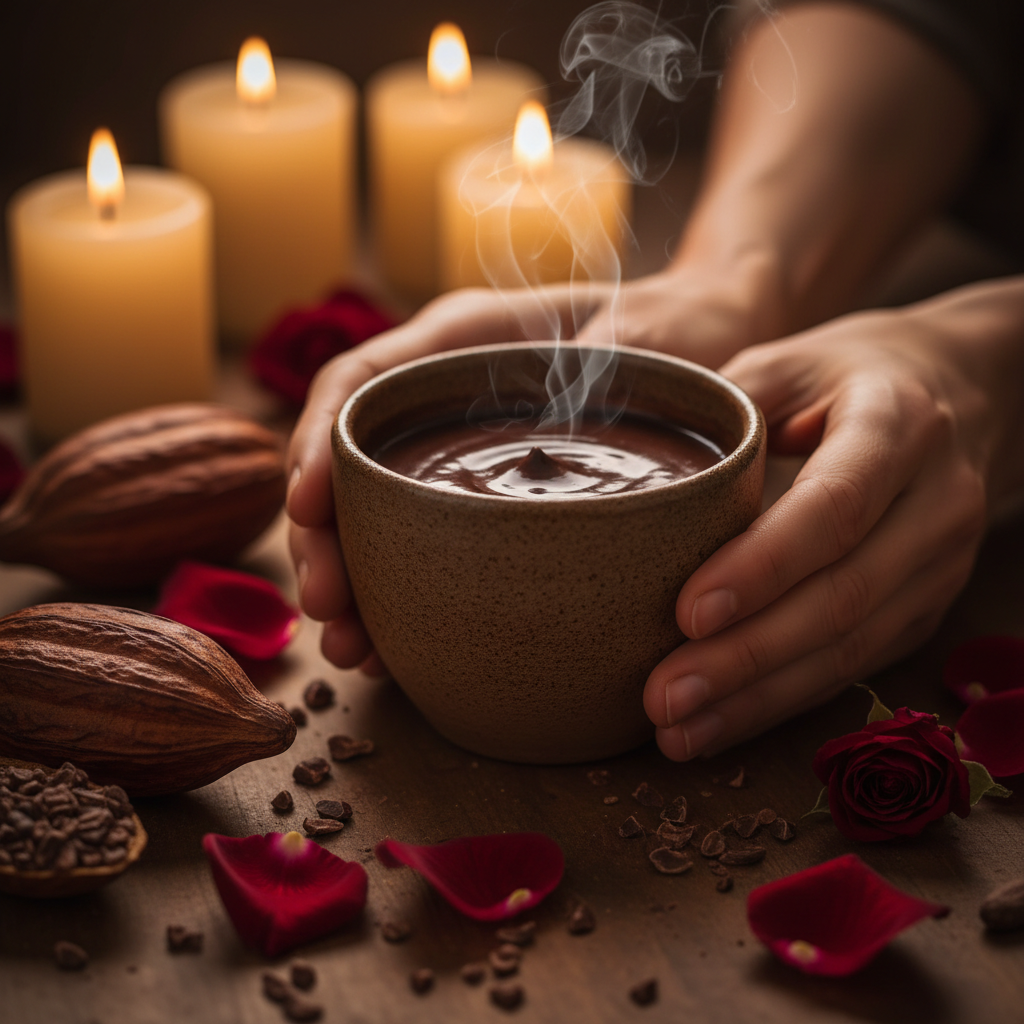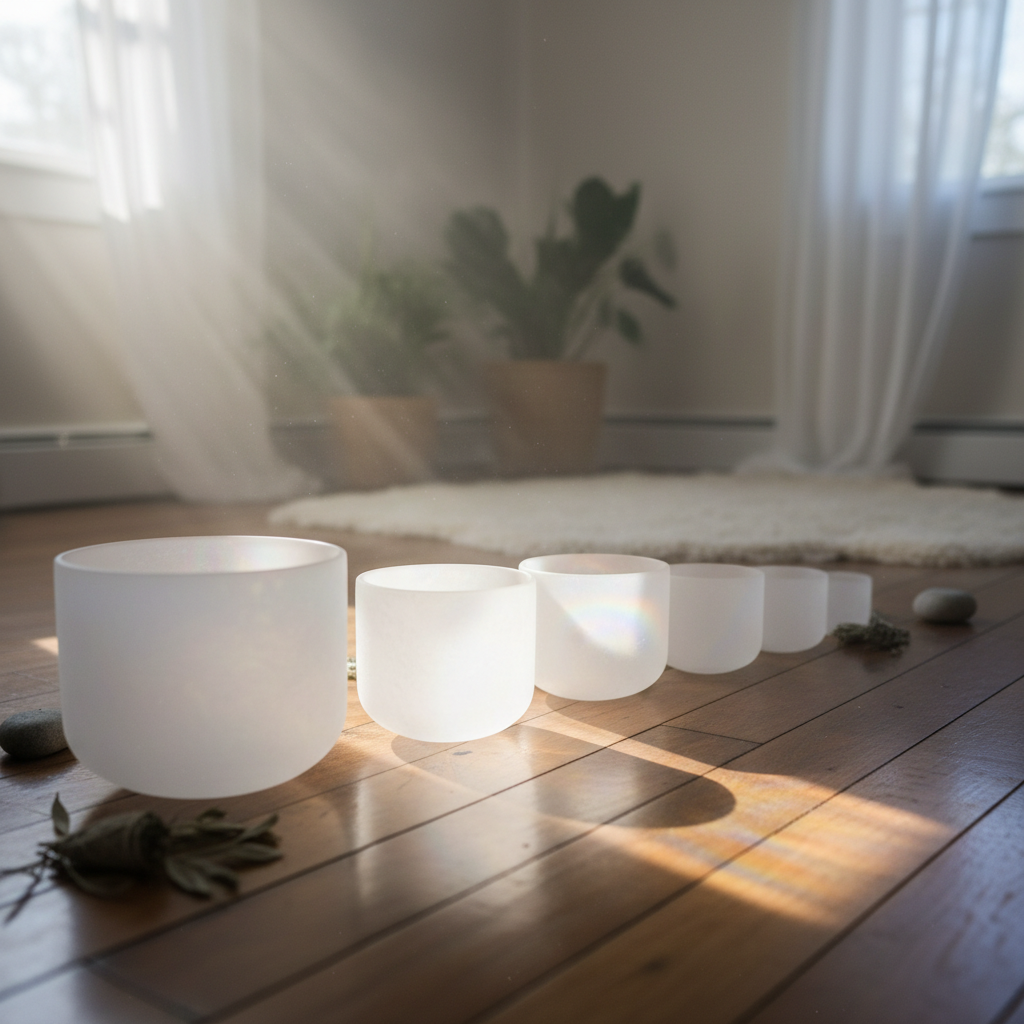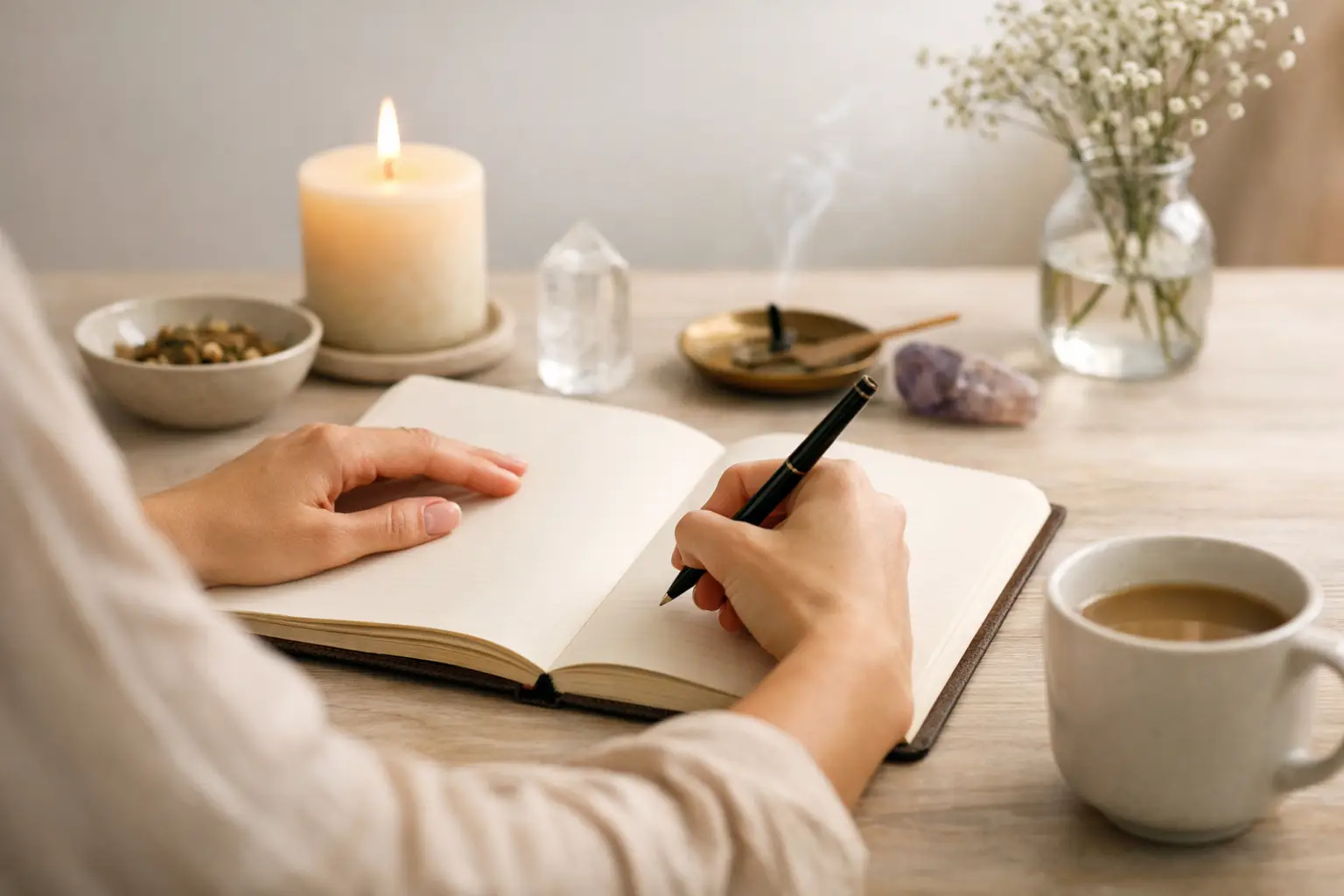
A ritual can leave you feeling open, softened, stirred or unexpectedly quiet. After cacao, a sound bath, breathwork or a personal moment of intention, the mind may want to make meaning while the body is still processing. Learning how to journal after rituals offers a gentle bridge between the experience itself and the life you return to afterwards.
This is not about producing beautiful pages or finding a profound answer every time. It is about giving what arose a safe place to land. A few honest words can help you recognise a feeling, honour an insight, or notice what your nervous system needs before you move back into the pace of the day.
Why journalling after ritual can feel so supportive
Ritual invites a different quality of attention. In a guided cacao ceremony, for example, you may become more aware of an emotion that has been waiting beneath daily responsibilities. During a sound bath, thoughts may recede enough for an image, memory or bodily sensation to come forward. These experiences do not always arrive as clear messages. Often, they arrive as texture: warmth in the chest, tears without a story, a sense of release, resistance, relief or spaciousness.
Journalling can help you meet this material without rushing to interpret it. It creates a moment of psychological grounding alongside spiritual expansion. Rather than asking, “What does this mean?” straight away, you might begin with, “What happened within me?” That small shift makes room for truth before analysis.
It also helps to remember that not every ritual needs to lead to a breakthrough. Sometimes the most valuable reflection is simply, “I feel more settled than I did an hour ago.” Sometimes you may feel raw, distracted or unchanged. Your journal can hold that, too. Honest reflection is more useful than forcing a meaningful narrative.
How to journal after rituals without breaking the atmosphere
Give yourself a short pause before reaching for the page. Drink some water, sit beneath a blanket, look out of a window or place both feet on the floor. If your practice has been particularly emotional or physically intense, allow a few minutes for your breathing and surroundings to become familiar again.
Then choose the form that feels least demanding. You might write full sentences, fragments, single words or a list of sensations. You could draw a shape, circle a colour, or let your handwriting be loose and untidy. The purpose is not to record the ritual perfectly. It is to stay in kind contact with yourself.
Start with what is immediate and observable. Notice the room, the temperature, your breath, the weight of your body and the emotions closest to the surface. This helps prevent reflection from becoming overly abstract, especially when a ritual has opened something tender.
A simple opening can be enough: “Right now, I notice…” Continue for five or ten minutes, stopping before the practice begins to feel like another task. Consistency is helpful, but pressure is not. Some rituals may call for three pages; others may need only one clear line.
Begin with the body
The body often offers the most truthful starting point. Before seeking a message, ask where you feel settled, tense, open, tired or alive. You might write: “My shoulders feel lower,” “There is a heaviness behind my eyes,” or “My chest feels wide, but I do not yet know why.”
This kind of language is valuable because it does not demand certainty. It lets you acknowledge experience as it is. For those used to living in thought, returning to sensation can be a quiet practice of embodiment.
Let emotion be present without making it a problem
A ritual may bring up grief, anger, joy or a feeling that is harder to name. Try not to turn the page into a courtroom where every emotion must be justified. Instead, describe the feeling with compassion. What colour, temperature, movement or weather does it resemble? What does it seem to need from you today?
If an emotion feels overwhelming, narrow the focus. Write down five things you can see. Name the support available to you in the room. Remind yourself that you can pause, close the journal and return later. Spiritual practice should not require you to push past your capacity. Safety and pacing are part of the practice.
Notice insights, then test them gently
Sometimes an inner realisation arrives with striking clarity: a boundary you need to set, a conversation you have been avoiding, a creative desire, or a need for more rest. Record it before the details fade, but leave room for discernment.
You do not need to act on every insight immediately. Ask whether it still feels true after food, sleep and ordinary life have returned. A ritual can clarify what matters, yet a grounded response may take time. Consider writing, “What is one small, caring action I could take?” This turns reflection into a realistic next step rather than a demand for dramatic change.
Prompts for journalling after a cacao ceremony or sound bath
When the blank page feels too wide, a prompt can offer a gentle threshold. Choose one or two rather than trying to answer them all. Let your response be private, imperfect and complete enough for this moment.
- What did I notice in my body during and after the ritual?
- Which emotion asked for my attention?
- Was there a word, image, memory or sensation that stayed with me?
- What felt nourishing, difficult or surprising?
- What am I ready to release, even a little?
- What would support me in integrating this experience over the next day or week?
- What is one way I can honour myself after this practice?
For a cacao ceremony, you may also reflect on your relationship with receiving, softness, pleasure or connection. For a sound bath, notice whether particular tones, silences or moments of stillness seemed to touch something within you. There is no fixed symbolism to decode. Your own associations matter more than a prescribed interpretation.
Create an integration rhythm, not a performance
The value of ritual journalling often becomes clearer over time. When you return to your pages after several practices, you may notice patterns: recurring emotions, a need for stronger boundaries, a growing sense of self-trust, or a theme that is slowly changing shape. These patterns can be illuminating, but they are not a scorecard for healing.
A simple rhythm may be more sustainable than an elaborate routine. Keep a dedicated notebook near where you join your online ceremony, or make a note on your phone if that is what is available. You might journal immediately after a ritual, then return the next morning for a brief check-in. The first entry catches the felt experience; the second may offer perspective.
It depends on your temperament, too. Some people need to write while the experience is fresh. Others need silence first, and find that words come more naturally hours later. Neither approach is more spiritual or more correct. The most supportive practice is one that respects your own pace.
When your journal brings up more than you expected
Reflection can occasionally uncover feelings that need more support than a journal can provide. If you feel persistently distressed, disconnected, unsafe or unable to return to your daily life after a practice, reach out to a trusted person or an appropriately qualified mental health professional. Ritual can be deeply meaningful, but it is not a replacement for therapeutic care when that care is needed.
You can also make your next ritual gentler. Choose grounding music rather than an intense practice, shorten the time you spend reflecting, eat something nourishing, and prioritise rest. At Luminous Resonance, we hold ritual as a space for compassionate self-encounter, not a demand to excavate more than you are ready to hold.
The page does not ask you to be enlightened, eloquent or certain. It simply offers a place to meet yourself with attention. Let your final words be small if they need to be: “I am here. I am listening. I can take the next gentle step.”