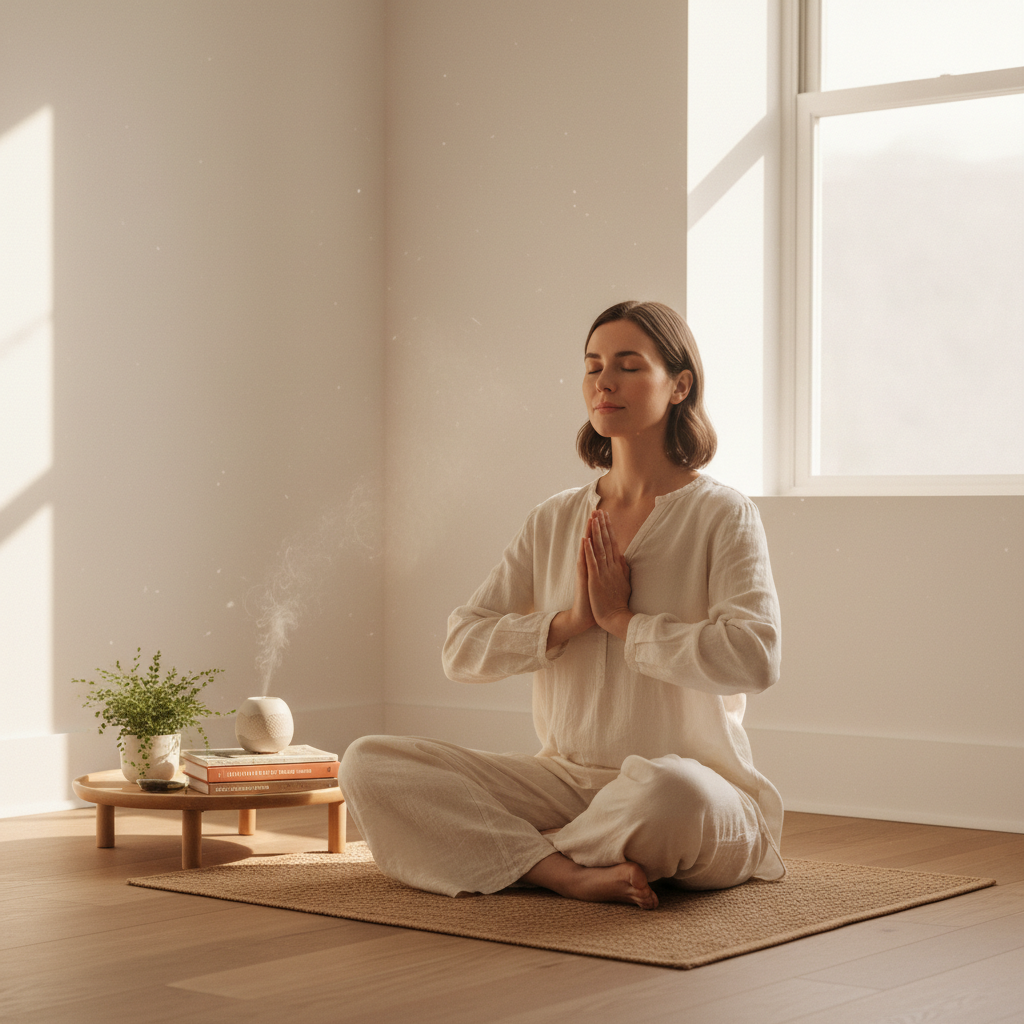
There are days when rest feels strangely out of reach. You may finish work, close the laptop and still feel your chest held tight, your thoughts moving quickly, or your attention pulled towards the next demand. This nervous system settling guide is not an invitation to force calm. It is a gentle way of offering your body repeated evidence that, in this moment, it may soften.
Settling is often quieter than we expect. It is the return of a fuller breath, the ability to notice the room around you, or the small feeling that you no longer need to solve everything at once. These shifts matter because the nervous system learns through experience. A few minutes of safety, repeated with care, can become a steadying rhythm.
What settling the nervous system really means
Your nervous system is always receiving information from within and around you. Deadlines, conflict, poor sleep, noise, uncertainty and even a crowded diary can signal that you need to stay alert. This protective response is not a personal failure. It is your body attempting to help you meet what feels demanding.
Settling does not mean becoming passive, detached or perfectly peaceful. It means supporting a move out of persistent survival mode and towards enough safety to think clearly, feel what is present and make a considered choice. At times, you may need energy and mobilisation. Before a difficult conversation or a creative deadline, a little activation can be useful. The intention is flexibility, rather than chasing a permanent state of calm.
For many people, the most supportive question is not, “How do I get rid of this feeling?” but, “What would help me feel five per cent more here?” That smaller invitation is often more believable to the body.
Begin with the conditions around you
Before reaching for a technique, notice your environment. The nervous system does not settle solely through inner work. It also responds to light, sound, temperature, pace and whether you feel you have permission to pause.
Choose one small signal of ease. You might make a warm drink, lower a harsh light, put your feet on the floor, or step outside for two unhurried minutes. If your day has been full of screens and decisions, avoid asking yourself to sit motionless in silence immediately. A slow walk around the room, a stretch at the doorway or gently shaking out your hands may be a more honest bridge towards stillness.
This is not about creating a flawless ritual. A beautiful altar, a candle and uninterrupted time can be nourishing, but they are not requirements for regulation. A hand resting over your heart while the kettle boils can be meaningful too. Consistency is usually more supportive than intensity.
Let your exhale become an anchor
Breath can be a direct way to communicate steadiness, provided it feels comfortable. Rather than taking a dramatic deep breath, which can occasionally create more tension, begin by letting the out-breath lengthen slightly.
Try breathing in naturally, then exhaling as though you are softly steaming a mirror. Do this for four or five rounds. Let your shoulders be as they are. There is no need to perform relaxation.
If breath-focused practices make you feel light-headed, anxious or more aware of panic, step away from them. Look around the room instead. Name three colours you can see, feel the support beneath you, or listen for the furthest sound you can hear. Regulation is personal, and the right practice is the one that leaves you with more choice, not less.
Use sensory grounding without turning it into a task
When the mind is racing, sensory information can offer a way back to the present. Feel the texture of a blanket. Notice the warmth of a mug between your palms. Place one hand on your thigh and press down gently, sensing the firmness underneath.
Sound can be especially powerful because it asks little of the thinking mind. A slow, spacious sound bath may help create a container in which the body can rest from constant interpretation and planning. Yet it depends on your sensitivity and your state that day. If layered sounds feel too immersive, choose a familiar, quieter track or simply sit with the natural sounds in your home.
The aim is not to disappear into an experience. It is to remain connected to yourself within it.
A nervous system settling guide for the moments between things
Many of us wait until we are exhausted before offering ourselves care. A more sustainable practice is to create brief transitions between one part of the day and the next. The nervous system benefits from endings that are clear enough to register.
After work, stand at a window before opening your phone. Before you enter your home, pause outside for one breath and feel the ground beneath both feet. After a difficult call, wash your hands slowly and let that simple act mark a return to yourself. These are modest gestures, but they interrupt the feeling that every demand is flowing into the next.
You might also create a short evening threshold. Put away one unfinished task, dim the room and write a single sentence in a journal: “Right now, I notice…” Do not edit it or turn it into a lesson. The purpose is acknowledgement. What is witnessed with gentleness often needs less effort to shout for attention.
When emotion arrives with the settling
Sometimes, when the body begins to slow down, emotion rises. You may feel tearful after a sound practice, unexpectedly tired after a busy week, or aware of sadness that was easier to outrun while occupied. This does not necessarily mean you are doing anything wrong. Stillness can make room for what has been waiting.
Meet this carefully. Keep your eyes open if that feels safer. Orient to the room. Drink water. Place a hand on your chest or abdomen only if touch is comforting. You do not need to analyse every sensation or transform every feeling into insight.
There is a difference between being gently moved and feeling overwhelmed. If a practice leaves you flooded, disconnected, panicked or unable to return to your day, reduce the intensity next time. Shorter sessions, more external grounding and support from a qualified mental health professional can be wise. Ritual can be deeply supportive, but it is not a replacement for trauma-informed clinical care when that care is needed.
Bringing ritual into a grounded practice
Ritual gives attention a shape. It can tell the body, “This time is different. I am allowed to arrive.” For some, ceremonial cacao before a reflective practice creates warmth, intention and a sense of connection. For others, particularly those who are sensitive to stimulants, already anxious, pregnant, or managing a health condition or medication, cacao may not be the most settling choice. Decaffeinated herbal tea or warm water can hold the same intention.
The sacredness is not contained in an ingredient. It is carried by your presence, your pace and the care with which you meet yourself. At Luminous Resonance, this balance between spiritual expansion and psychological grounding is central: a practice can be reverent without asking you to leave your body behind.
Consider choosing one simple opening phrase before a quiet practice: “For the next ten minutes, nothing is required of me.” Then choose a closing act, such as placing both feet on the floor, opening a window or writing down what you need next. Beginning and ending clearly can make an experience feel held rather than unfinished.
Let settling be relational, too
Co-regulation is a real human need. Sometimes the nervous system settles most readily in the presence of someone who feels steady, kind and unhurried. This might be a friend who listens without trying to fix you, a therapist, a trusted colleague or a guided group space where there is room to be quiet.
You do not have to explain every detail to receive support. A simple message such as, “I have had a full day and could use a calm voice,” can be enough. Connection is not an indulgence after stress has passed. It can be part of how the stress response completes.
There will be days when no practice creates instant peace. On those days, let your measure of success be smaller: you paused, you noticed, you offered your body one honest signal of care. Over time, this is how a digital sanctuary becomes an inner one too - not through perfection, but through returning with compassion whenever you can.