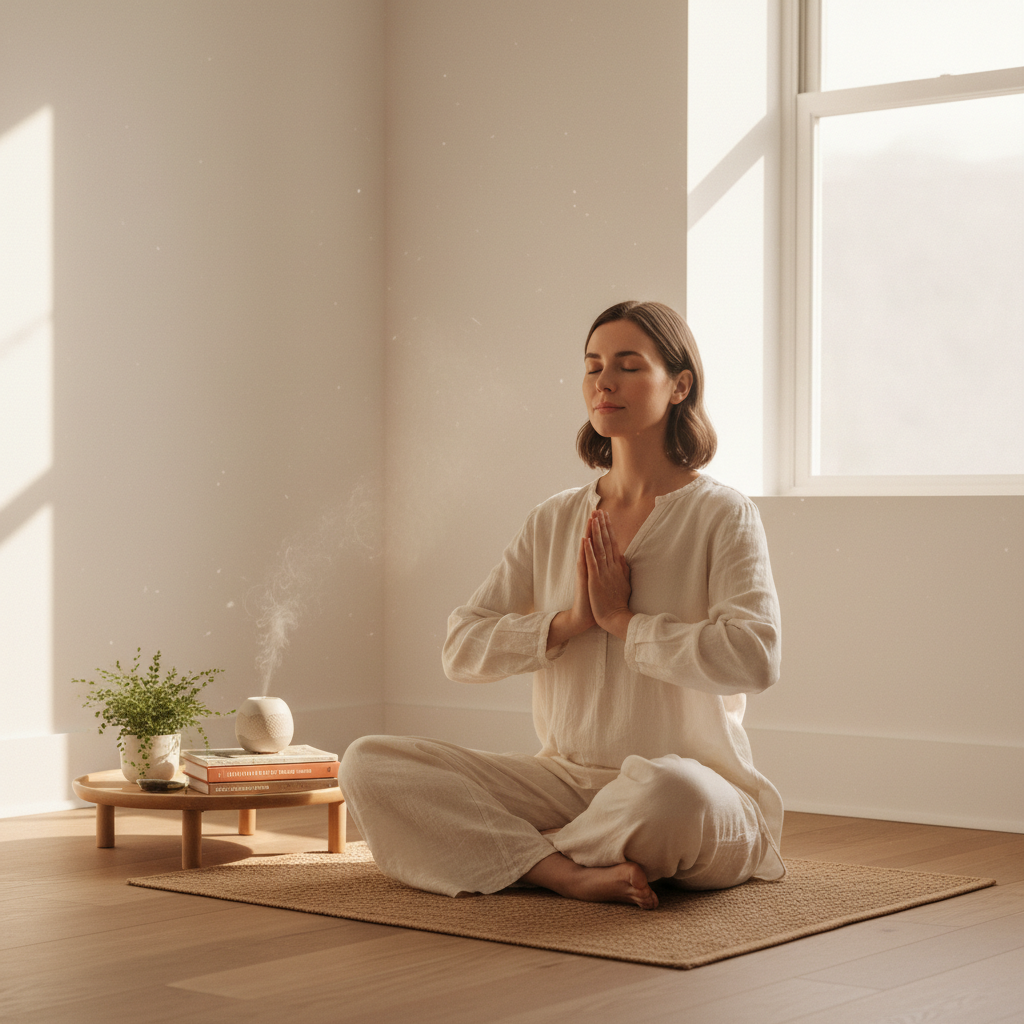
There is a quiet difference between feeling calm and feeling anchored. You might finish a meditation, a sound bath, or a heartfelt journal practice feeling open, tender, even expanded - yet still slightly unsteady. That is where psychological grounding meaning becomes especially useful. It speaks to the inner sense of being present, safe enough, and connected to yourself while moving through emotion, insight, and spiritual practice.
Psychological grounding meaning in simple terms
Psychological grounding meaning is the process of returning your awareness to the present moment in a way that helps you feel more stable, regulated, and connected to reality. It is often used when emotions feel intense, thoughts become fast or scattered, or the body starts signalling stress through tension, numbness, or restlessness.
Grounding is not the same as suppressing feeling. It does not ask you to become less sensitive, less spiritual, or less open. Instead, it supports your capacity to stay with your experience without becoming overwhelmed by it. In therapeutic language, grounding helps orient the nervous system towards safety. In spiritual practice, it creates a steadier base for insight, ritual, and inner listening.
That is why grounding matters so deeply in healing work. Expansion without steadiness can feel disorientating. Reflection without embodiment can remain abstract. A grounded state allows experience to settle into the body rather than simply passing through the mind.
Why grounding matters emotionally and spiritually
Many people first seek grounding when life feels too much. Work pressure builds, sleep becomes light, emotions sit close to the surface, and even nourishing practices can feel harder to receive. In that state, grounding offers something very practical - a way back into the body, the breath, and the room you are actually in.
Yet grounding is not only for moments of distress. It also matters in rituals and reflective practices because deep inner work can open material that needs care. A cacao ceremony may soften emotional defences. A sound bath may bring memory, grief, relief, or clarity to the surface. Meditation may reveal how much has been held beneath the pace of daily life. Without grounding, these moments can feel vague or uncontained. With grounding, they become more integrated.
For many people, this is the missing piece. They are not looking only for relaxation. They want a sense of emotional safety that can hold both tenderness and transformation. Psychological grounding offers that bridge. It honours the nervous system while making space for spiritual depth.
What psychological grounding can feel like
Grounding rarely looks dramatic. More often, it is subtle and deeply human. Your breathing may lengthen without force. Your thoughts may slow enough for choice to return. You may notice the chair beneath you, the floor under your feet, or the simple fact that you are here now and not inside every thought at once.
Some people experience grounding as warmth, heaviness, or a clearer sense of physical boundaries. Others feel it as orientation - noticing the sounds in the room, the light through a window, or the texture of a blanket. For someone who tends to live in their head, grounding can feel like coming home to the body. For someone who feels emotionally flooded, it can feel like a gentle return to shore.
It is worth saying that grounding does not always feel instantly peaceful. At first, coming back into the body can bring awareness of tiredness, sadness, or tension that had been pushed aside. This is not failure. It is often the beginning of honesty. Grounding creates enough steadiness to notice what is true.
Psychological grounding meaning versus relaxation
These two ideas often overlap, but they are not identical. Relaxation is about easing activation. Grounding is about orienting to the present with enough stability to remain connected.
You can feel relaxed but not grounded. This sometimes happens after scrolling, zoning out in front of a screen, or drifting through a pleasant meditation without really landing in yourself. You can also feel grounded without feeling completely relaxed. For example, during a difficult conversation, you might still feel emotion in the body, but you remain present, aware, and able to respond rather than disappear into reactivity.
This distinction matters because many wellbeing practices are described only in terms of calm. Calm is lovely, but it is not always the most useful measure. At times, what the nervous system needs is not softness alone but structure, orientation, and a sense of inner contact.
How grounding supports the nervous system
When the nervous system senses threat, even subtly, it may move towards fight, flight, freeze, or a kind of disconnected functioning that looks capable from the outside but feels brittle within. Grounding practices help interrupt that spiral by giving the mind and body immediate, sensory evidence of the present moment.
That might mean noticing five things you can see, pressing both feet into the floor, holding a warm mug, or naming where you are and what day it is. These simple acts are powerful because they reduce the distance between awareness and reality. They tell the system, gently, that this moment can be met.
Of course, grounding is not a cure-all. If someone is moving through trauma, panic, grief, or ongoing mental health difficulty, grounding may help but may not be sufficient on its own. Sometimes it works best as part of wider support, including therapy, rest, boundaries, and compassionate routine. That does not lessen its value. It simply keeps the practice honest.
Grounding in ritual and reflective practice
In a spiritually attuned space, grounding can sometimes be misunderstood as the opposite of transcendence, as if being rooted in the body might dilute the sacred. In truth, the opposite is often closer to reality. The body is not a barrier to spiritual work. It is where much of that work becomes real.
When grounding is woven into ritual, it helps create containment. Before a ceremony, grounding can mark the transition from ordinary busyness into intention. During the practice, it helps you stay connected to your felt experience. Afterwards, it supports integration so that insight does not remain fleeting.
This is especially relevant in digital spaces, where people enter practice from kitchens, bedrooms, or laptops balanced at the end of the bed. The ritual may be beautiful, but the environment is still everyday life. Grounding helps bridge the sacred and the ordinary. It allows an online session to become more than passive listening. It becomes embodied participation.
At Luminous Resonance, this meeting point between psychological grounding and spiritual expansion is part of what makes practice feel both safe and meaningful. The ritual opens the heart. The grounding helps it land.
Gentle ways to practise grounding
The most effective grounding practices are often the least complicated. If a method feels performative or overly elaborate, it may pull you further from yourself rather than closer.
Begin with physical orientation. Feel where your body is supported. Let your feet meet the floor. Notice temperature, texture, weight, and contact. Then let your breath be natural rather than improved. The aim is not to achieve a perfect inhale but to recognise that breathing is already happening.
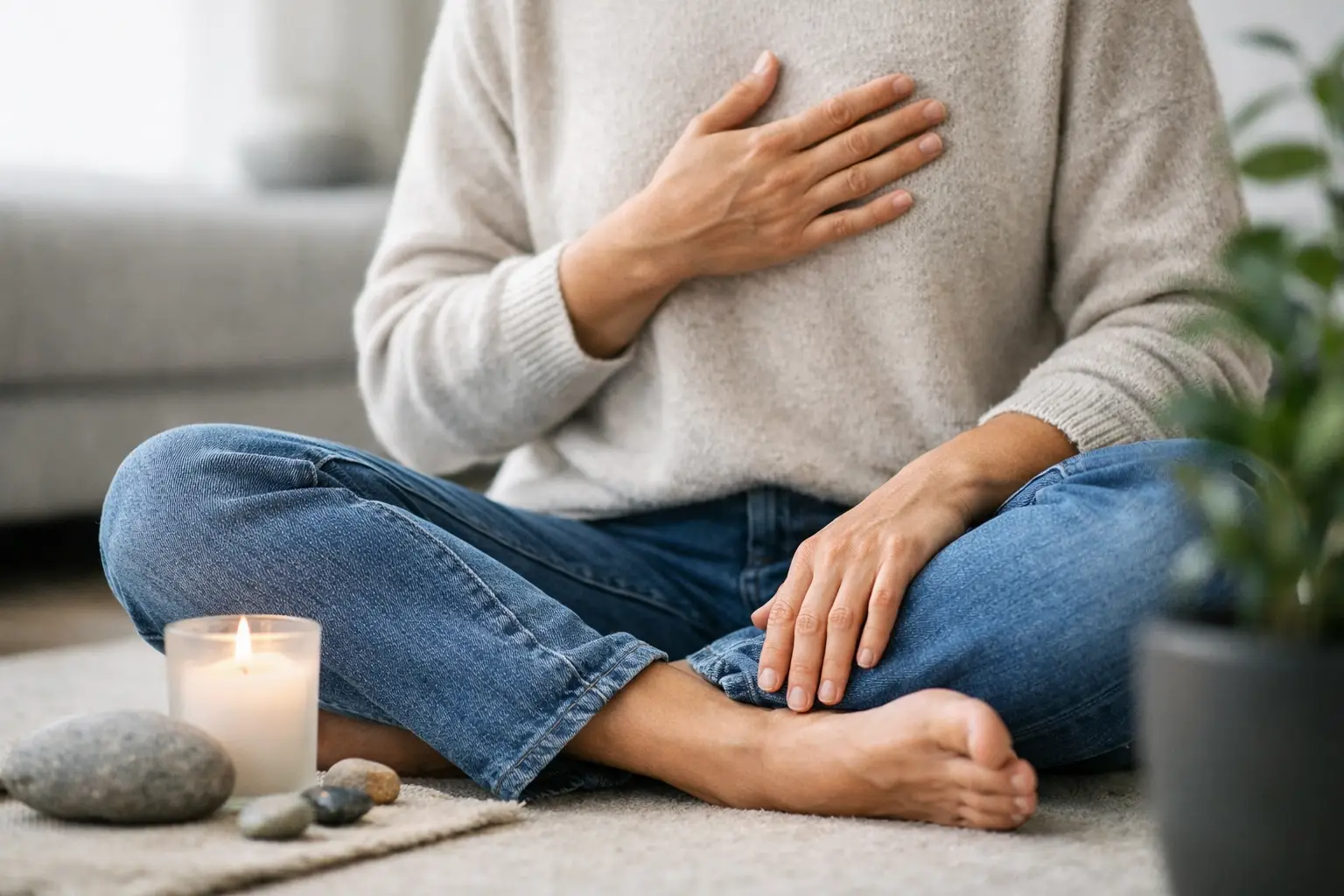
You can also use language. Quietly naming what is here - a candle, rain at the window, the fabric on your skin, the sound of your own breath - can help settle a spinning mind. Some people find comfort in touch, such as one hand on the chest and one on the lower belly. Others respond better to structure, such as sipping water slowly, wrapping in a blanket, or writing a few lines in a journal after practice.
What works will depend on the moment. If you are mildly stressed, breath and sensory awareness may be enough. If you feel dissociated or overwhelmed, stronger physical cues may help more, like standing up, walking, or pressing your back against a wall. The question is less "What is the best technique?" and more "What helps me feel here, now, and in contact with myself?"
When grounding becomes a deeper practice
Over time, grounding can become more than an emergency response. It can turn into a relationship with yourself built on consistency, honesty, and care. You start to notice earlier when you are leaving your body, bypassing emotion, or stretching beyond your real capacity. You also begin to trust that returning is possible.
This is where grounding becomes quietly transformative. It changes the quality of inner work. Reflection becomes more embodied. Boundaries become clearer. Rest becomes more restorative because you are actually inhabiting it. Even joy can be felt more fully when the system is not braced against life.
Psychological grounding meaning, then, is not just about coping when things feel difficult. It is about creating the conditions in which healing, ritual, and self-awareness can be received without losing yourself in the process.
If you are longing for practice that feels both sacred and steady, grounding is not a small preliminary step. It is part of the path itself - a soft return to the body, to the breath, and to the truth that presence can hold more than force ever will.