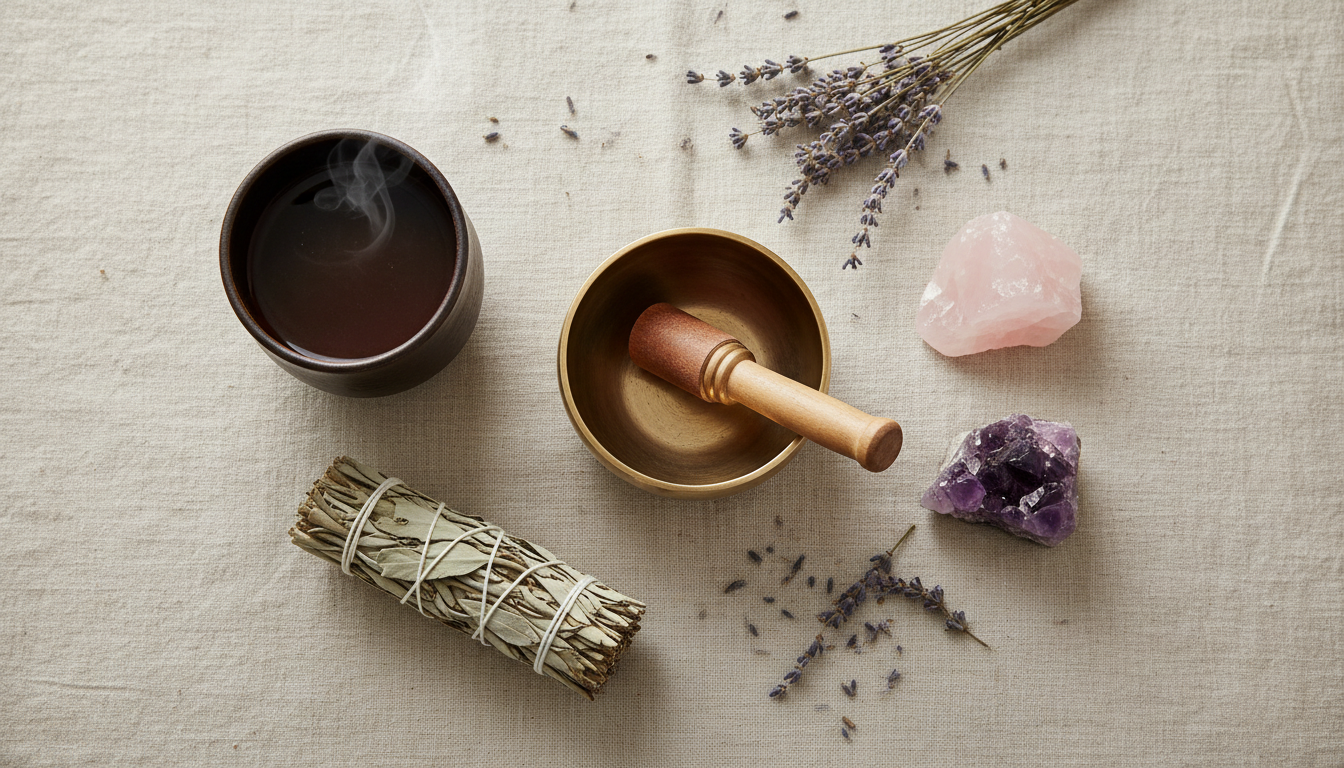
The moment before you lift your cup can shape everything that follows. Setting intentions before cacao is not about finding the perfect words or asking your practice to solve your life. It is a quiet decision to arrive honestly, to give your inner world a little more space, and to meet the ceremony with care.
For many of us, the day has already asked for our attention in ten different directions. A cacao ritual offers a gentle threshold between doing and being. Your intention becomes a way of crossing it: not a demand placed upon yourself, but a compassionate orientation for what you are ready to notice.
Why an intention changes the experience
Cacao can be a meaningful companion to meditation, breathwork, journalling or sound. Yet the ritual is not contained in the drink alone. It is also created by the pace you set, the environment you choose and the quality of attention you bring to yourself.
An intention gives that attention a home. It can help the mind settle when it is scattered, or offer a thread to return to when emotion, memory or sensation begins to move. Rather than trying to control your experience, you are acknowledging what feels alive in you and making room to listen.
This distinction matters. An intention is different from a goal. A goal may be, “I need to make a decision by Friday.” An intention might be, “I am willing to hear what I already know.” The first measures an outcome. The second supports a relationship with yourself.
There may be ceremonies when your intention is tender and clear: to soften grief, reconnect with creativity, or honour a transition. On other days, you may feel blank, tired or uncertain. That is not a failure of practice. “I intend to be present with what is here” is more than enough.
Setting intentions before cacao without pressure
Begin before the cacao is prepared, if you can. Put away what can wait. Choose a place where your body feels reasonably supported and uninterrupted, even if that is simply a chair by a window. You do not need an elaborate altar for the moment to be sacred. A candle, a journal, a blanket or a few minutes of quiet can be enough.
Take a little time to arrive in your body. Feel your feet on the floor. Notice whether your jaw is tight, whether your shoulders are lifted, whether your breath is shallow or full. There is nothing to correct. This is simply a way of letting your nervous system know that the pace is changing.
Then ask one simple question: What would feel supportive to receive from this time? Let the answer emerge without forcing it. You may sense a word, an image, a memory or a physical feeling before you can form a sentence.
Keep the language kind and spacious. Intentions often land best when they are expressed in the present tense and leave room for your own wisdom. For example: “I welcome clarity with gentleness.” “I allow myself to rest.” “I am open to meeting this feeling with compassion.” “I return to my body.”
If direct affirmations feel untrue or too polished, make the intention more honest. You might say, “I am willing to be curious about what I feel,” or, “For this next hour, I do not have to carry everything alone.” The right words are the ones your body does not need to argue with.
Let the body have a voice
A useful check is to speak your intention quietly, then notice your response. Do you feel a small settling in your chest or belly? Does your breath become easier? Or do you feel constricted, as though you have set yourself another task?
If it feels heavy, soften it. An intention should not become another standard to meet. “I will heal this pattern today” may hold a beautiful longing, but it can also create pressure. Try, “I offer this pattern my attention,” instead. Small changes in language can create greater emotional safety.
A simple ritual for your first sip
Once your intention has taken shape, hold the warm cup in both hands for a few breaths. Notice its weight, aroma and warmth. Let this be a sensory cue that you are entering a different kind of time.
You might silently repeat your intention three times. On the final repetition, take your first sip slowly. There is no need to search immediately for a profound feeling. The practice is the willingness to stay close to the present moment, whatever it contains.
From here, you can sit in silence, write freely in a journal, practise gentle movement, or settle into a guided sound bath. Choose what genuinely supports your capacity that day. Sometimes music and sound allow the mind to soften; sometimes silence is what you need. It depends on your energy, your environment and how resourced you feel.
If you are joining an online ceremony, your intention can help you remain connected to your own experience within a shared space. You do not need to compare your response with anyone else’s. A digital sanctuary can still be deeply personal when you give yourself permission to participate at your own pace.
When strong feelings arise
An intention can bring you closer to emotions that have been waiting beneath the surface. This can feel meaningful, but it is not always comfortable. If sadness, agitation or overwhelm rises, return to the most immediate forms of grounding: open your eyes, feel the floor, name a few objects in the room, or take a sip of water.
You are always allowed to pause. You are allowed to change your intention midway through the practice. “I am open to insight” may become “I choose steadiness now.” Listening to your limits is not stepping away from the ritual. It is part of practising with integrity.
Cacao contains naturally occurring stimulants, so it may not feel right for every body or every moment. Consider your own sensitivity to caffeine, current health needs and any guidance from a qualified healthcare professional. A smaller serving, an earlier ceremony time or a caffeine-free ritual may be the more caring choice. The depth of your practice is never measured by how much cacao you drink.
Carrying the intention beyond the ceremony
The most useful intentions often remain with you after the cup is empty. Before you return to messages, chores or work, take one minute to ask: What am I taking with me? The answer may be a practical action, such as taking a proper lunch break or sending an honest message. It may also be a quieter remembrance: soften your shoulders, speak to yourself with patience, make space to create.
Write a few words down if that helps. Not to preserve the ceremony perfectly, but to honour what you noticed. Over time, a journal can reveal the intentions that keep returning. Perhaps you are repeatedly seeking rest, permission, belonging or truth. These patterns are not problems to fix. They are invitations to know yourself more deeply.
At Luminous Resonance, we hold ritual as a meeting place for psychological grounding and spiritual expansion. The intention is not there to make the experience impressive. It is there to help you come home to what is real.
Before your next cup, let yourself choose one sentence that feels possible. Hold it lightly. Then allow the warmth, the breath and the quiet to show you what is ready to be heard.