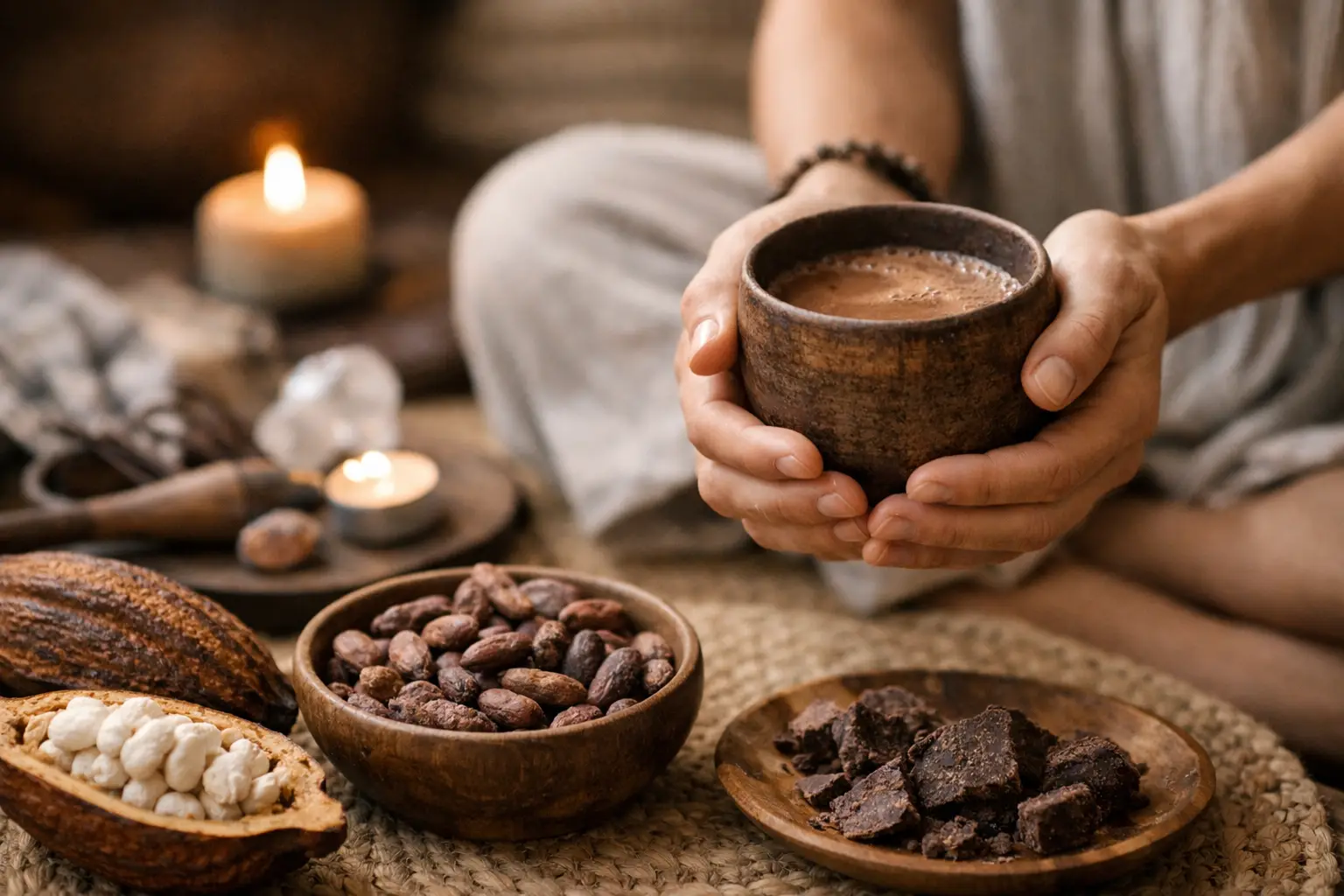
If you have ever wondered what do you do in a cacao ceremony, the simplest answer is this: you slow down enough to listen. A cacao ceremony is not about performing a belief system or getting anything right. It is a guided ritual space where drinking ceremonial cacao becomes a doorway into reflection, emotional softening, and a more present relationship with yourself.
For many people, the first surprise is how gentle it is. There is often a sense of sacredness, but not pressure. You are usually invited to arrive as you are, whether you feel open-hearted, tired, hopeful, unsettled, or simply curious. The ceremony creates a container where the body can settle, the mind can become less noisy, and something deeper can come into view.
What happens in a cacao ceremony?
Although each facilitator brings their own rhythm, most ceremonies follow a similar arc. There is an opening, a moment of connection with the cacao itself, a guided inner practice, and a period of integration. The experience can happen in person or online, and a well-held digital session can still feel intimate, grounding, and deeply supportive.
At the beginning, you will usually be guided into presence. That may mean a few quiet breaths, a brief meditation, soft music, or a simple invitation to notice how you are feeling. This part matters more than it may seem. Cacao ceremonies are not only about the drink. They are about preparing your inner landscape so the ritual feels intentional rather than rushed.
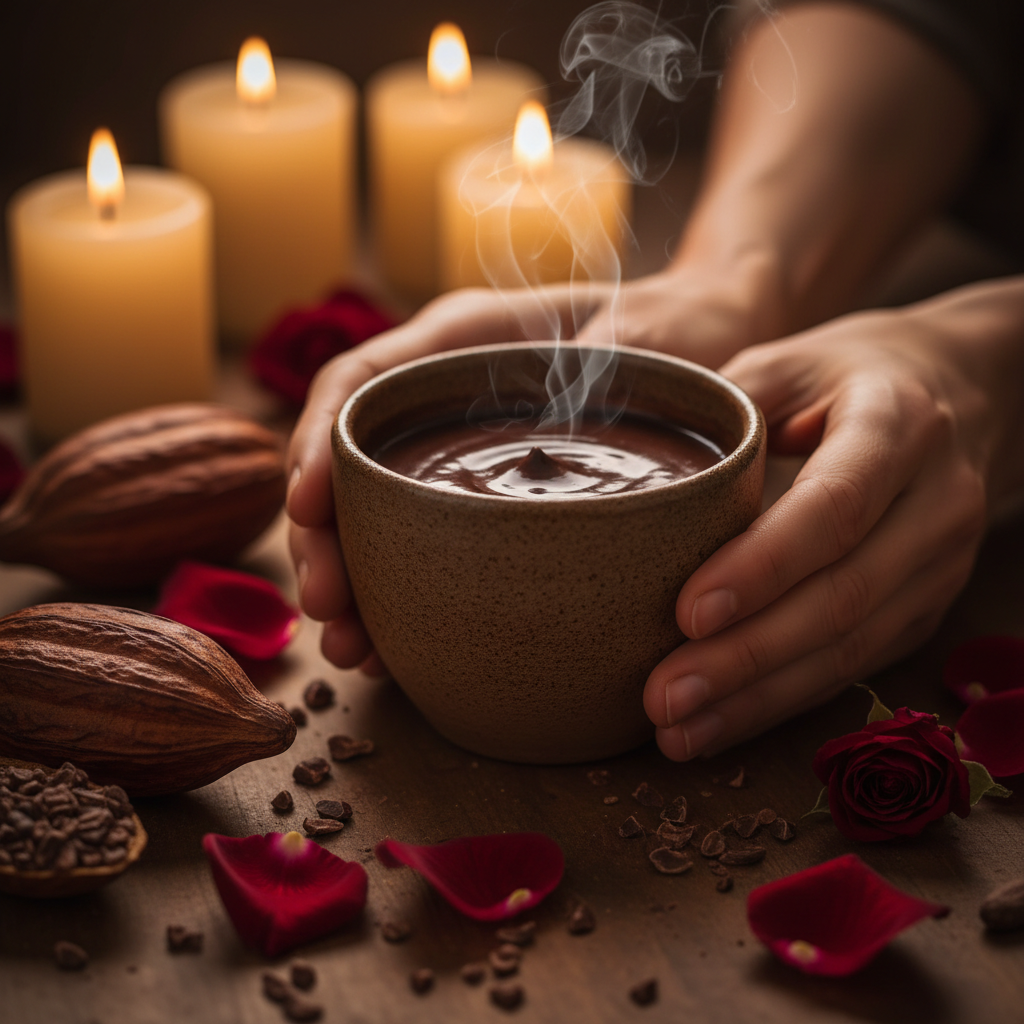
Next comes the cacao. Ceremonial cacao is prepared and offered with care, often as a warm drink. You may be invited to hold the cup with both hands, notice its scent, and take a moment of gratitude before drinking. Some facilitators speak about cacao as a plant ally or heart-opening medicine. Others use more therapeutic language, focusing on embodiment, emotional awareness, and nervous system regulation. Both approaches can sit well together when the space is held with integrity.
What do you do in a cacao ceremony, step by step?
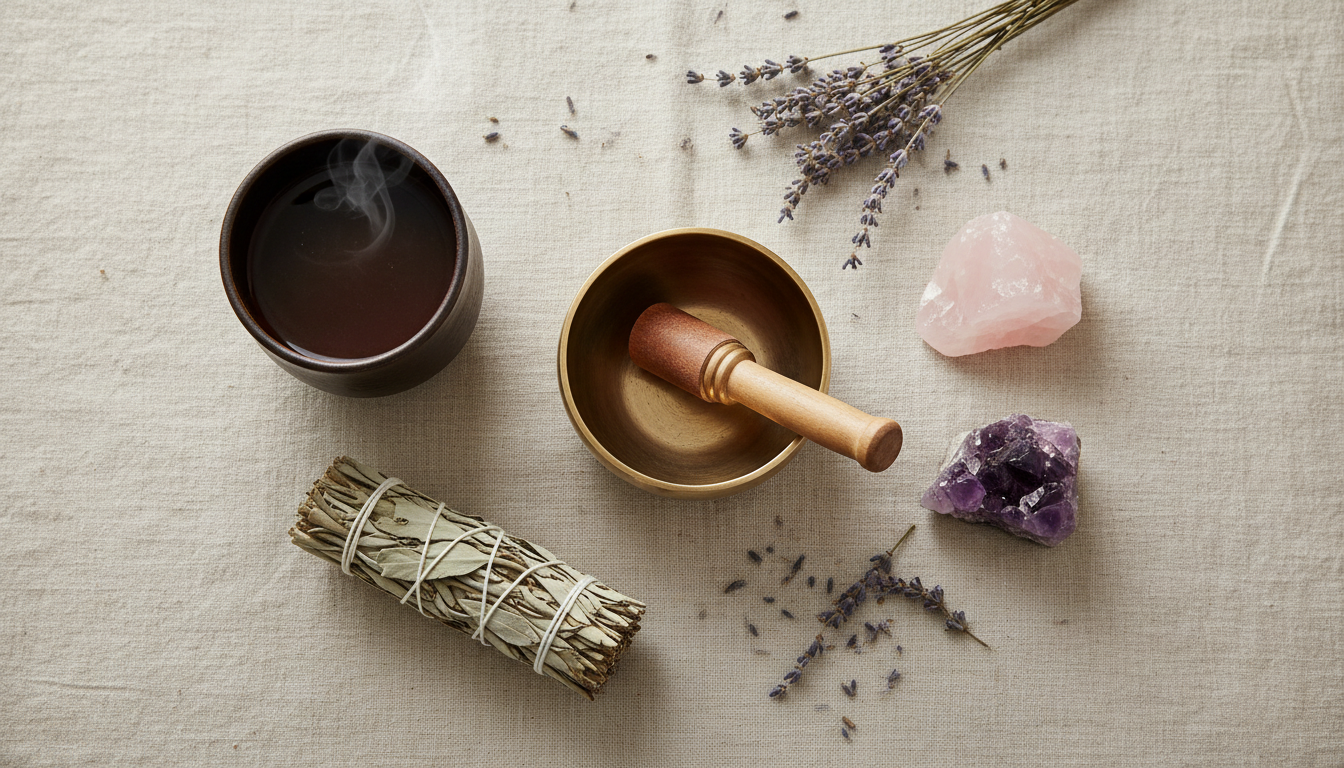
You begin by arriving deliberately. That may mean dimming the lights, putting your phone away, sitting somewhere comfortable, or creating a small altar with a candle, crystals, flowers, or a journal. None of this is compulsory. The point is not aesthetic perfection. The point is to signal to your system that this time is different from ordinary time.
Then you set an intention. This is not the same as making a demand of the ceremony. An intention is usually quieter than that. It might be a question, a feeling you want to understand, or a quality you want to cultivate. You may enter with something like, I want to soften my anxiety, hear my inner voice more clearly, or reconnect with my sense of trust. Sometimes the most honest intention is simply, show me what I need to see.
When you drink the cacao, you do so slowly. You notice taste, temperature, breath, and sensation. Ceremonial cacao contains naturally occurring compounds that many people experience as gently uplifting or heart-centred, but it is not a dramatic altered-state practice in the way some imagine. Often the shift is subtle. You may feel warmer, calmer, more emotionally available, or more connected to your body.
From there, the facilitator may guide meditation, breathwork, visualisation, journalling, sound healing, or gentle movement. Some ceremonies include sharing, though not all do. In a carefully held space, silence can be just as powerful as spoken reflection. The real practice is less about doing more and more about letting yourself be with what arises without immediately shutting it down.
The inner work at the centre of the ritual
A cacao ceremony can feel spiritual, but it is also profoundly relational and psychological. Beneath the candlelight and music, what many people are really doing is practising safe inner contact. They are noticing emotion without judgement. They are listening to the body. They are allowing grief, tenderness, gratitude, clarity, or uncertainty to have a little more room.
This is why cacao is often paired with therapeutic grounding. Without grounding, spiritual practices can become abstract or overwhelming. With grounding, the ceremony becomes a place where insight is not just inspiring but usable. You might leave with a beautiful feeling in your chest, but also a more concrete understanding of what needs care in your life.
It is worth saying that not every ceremony brings revelation. Sometimes the gift is quiet. Sometimes the most meaningful experience is that you finally rested. Sometimes what emerges is resistance, distraction, or numbness. That does not mean the practice failed. It may mean your system is showing you exactly where gentleness is needed.
How it may feel during the ceremony
There is no single correct experience. Some people feel expansive and emotionally moved quite quickly. Others stay observant, grounded, and calm throughout. You may feel a soft opening in the chest, tears close to the surface, greater compassion for yourself, or a deep sense of stillness.
You may also feel very little at first, especially if you are tired, guarded, or new to ritual practice. That is completely valid. Cacao is not there to force an emotional breakthrough. It supports a process, but your own readiness, the environment, the guidance, and your physical state all shape the experience.
This is one reason the quality of facilitation matters. A good ceremony does not push vulnerability for its own sake. It offers enough structure for safety and enough spaciousness for honesty. For people who spend much of their lives holding things together, that balance can be deeply restorative.
What to expect after a cacao ceremony
The ceremony does not necessarily end when the closing words are spoken. Often the real integration begins afterwards. You may feel lighter, clearer, and quietly nourished. You may also feel tender or more emotionally aware than usual. If something meaningful surfaced, it can continue unfolding over the next few hours or days.
This is why post-ceremony reflection is so valuable. Journalling, resting, walking, or simply keeping the evening gentle can help the experience settle. Rather than rushing back into noise, it helps to stay close to what moved in you. If you received an insight, ask what it is asking of your life. If you felt grief, ask what support that grief needs. If you felt peace, notice what conditions helped you access it.
At Luminous Resonance, this integration is part of the wider rhythm of practice. A ceremony can open the door, but reflection is often where the deeper transformation becomes tangible.
Is there anything you should avoid?
It depends on your body and your context. Ceremonial cacao is not suitable for everyone in every circumstance, and that deserves respect rather than fear. If you are pregnant, highly sensitive to stimulants, or taking medication that may interact, it is wise to seek appropriate guidance beforehand. A responsible facilitator should never present cacao as universally suitable.
It also helps to avoid arriving in a rushed, scattered state if you can. You do not need to be perfectly calm before you begin, but giving yourself even ten quiet minutes beforehand can make the experience more supportive. Eating very heavily right before the ceremony may not feel comfortable for some people, while arriving completely depleted may leave you feeling ungrounded. There is no rigid rule, only the invitation to be attentive.
If you are attending your first cacao ceremony
Bring less performance and more honesty. You do not need to know the right words, have a spiritual background, or be naturally expressive. The ceremony is not a test of openness. It is a practice of meeting yourself where you are.
If it helps, keep your intention simple. Drink slowly. Let the guidance support you without forcing an outcome. If emotion arises, allow it. If nothing dramatic happens, allow that too. The ceremony is still working on the level of presence, and for many people that is where healing begins.
A cacao ceremony is, at its heart, a gentle act of remembering. You pause, you listen, you feel, and you return to yourself with a little more compassion than before. If you let it be simple, that is often where its depth reveals itself.
The most helpful way to approach it is not to ask whether you are doing it perfectly, but whether you are willing to be present for what is true.